
By Justin Curatola
Whether you’re repairing a historic chimney, building a retaining wall, or restoring a 100-year-old porch, one decision will make or break your investment—hiring the right mason.
Masonry isn’t just brick and mortar. It’s structure, science, and legacy. Done correctly, it can last a century. Done poorly, it can cause tens of thousands of dollars in structural damage.
Before you sign any contract, here’s what you must know to protect your property and peace of mind.
1. ✅ Licensing Isn’t Optional—It’s the Law
Always ask:
➡️ “Are you licensed to do masonry in my city?”
In places like Columbus, Ohio, masonry is a licensed trade under local Building Code 4114. Contractors must pass city exams, carry insurance, and maintain bonds to legally perform masonry work. If your contractor can’t provide their license number, you’re at risk—financially and structurally.
🔍 Pro Tip: Look them up on the Columbus Contractors License Board (https://www.columbus.gov/bzs/contractor-licensing/Approved-General-Contractors/).
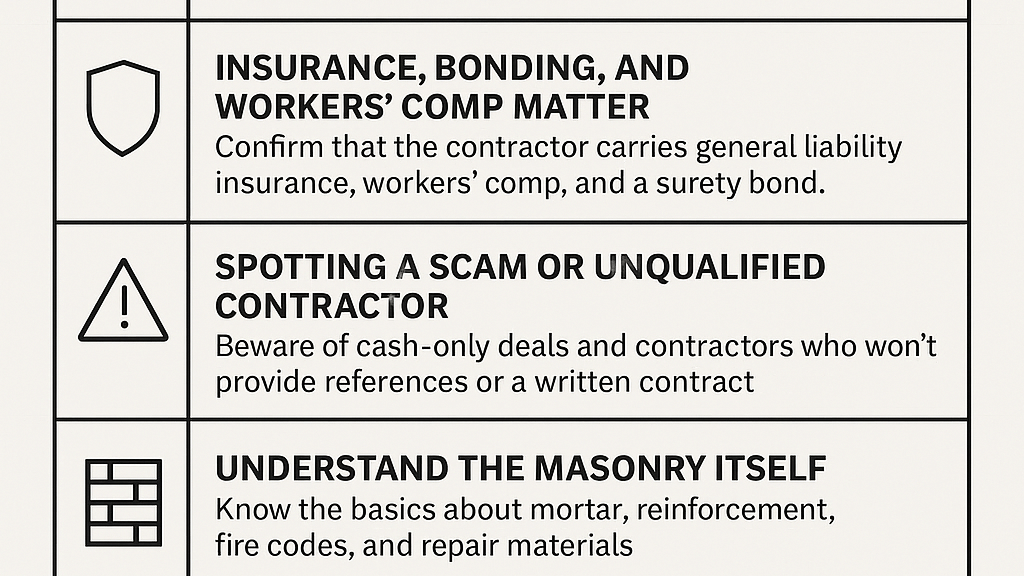
2. 🧾 Insurance, Bonding, and Workers’ Comp Matter
It’s not just about protecting the contractor—it’s about protecting you. If a crew member gets injured on your property and the company isn’t covered, you could be liable.
Make sure your mason carries:
• General Liability Insurance
• Workers’ Compensation
• Bonding for Permits and Compliance
3. 🚩 Spotting a Scam or Unqualified Contractor
Unfortunately, many homeowners fall for red flags like:
• “We can do it this weekend, cash only.”
• “No need for permits.”
• “That crack is cosmetic—we’ll just caulk it.”
Ask for references. Ask to see previous work. And get everything in writing—scope, price, timeline, and warranty.
4. 🧱 Understand the Masonry Itself
Know these basics before you build:
• Tuckpointing is not a cure-all. It’s only effective when mortar is properly removed and matched (ASTM C270 and C1713).
• CMU block needs reinforcement for structural use (TMS 402/602).
• Chimneys have strict fire codes under IRC R1003.
• Historic mortar requires lime-based repair—Portland cement can destroy old brick.
💡 A good mason will explain what type of mortar, brick, stone, or block is best for your structure—and why.
5. 🧰 Ask About Process, Protection, and Cleanup
A quality mason should:
• Cover and protect surrounding areas.
• Use dust control and OSHA-compliant equipment.
• Provide clean-up and haul-off at the end.
• Take before and after pictures for your records.
Don’t settle for someone who “eyeballs it.” Demand a craftsman with a system.
6. 📸 Inspections, Permits, and Professional Reports
For larger jobs (like chimneys, foundations, or load-bearing walls), get:
• A written estimate with terms and scope.
• A structural disclaimer or stamped engineer report if needed.
• A permit from your city or municipality if the work is structural.
If your contractor doesn’t pull permits or refuses to document the work, walk away.
7. 🏛️ When Historic Means High-Stakes
Preserving historic masonry is not cosmetic work—it requires:
• Mortar analysis and matching (ASTM C1713).
• Brick sourcing or salvage matching.
• Use of breathable lime plasters, not waterproof coatings.
🛑 Using the wrong materials on historic homes can void preservation grants or tax credits and cause long-term damage.
Final Word: Protect Your Home. Hire the Right Mason.
At Curatola Masonry, we’re licensed, bonded, insured, and backed by over 25 years of award-winning craftsmanship. We follow building codes, industry standards, and preservation best practices—every single time.
Whether your project is new or 120 years old, we believe in doing it right, not fast. Because you’re not just paying for brick—you’re investing in your home’s safety, beauty, and longevity.
⸻
📞 Ready to Get Started?
Call us at 614-313-6642 or visit CuratolaMasonry.com (https://www.curatolamasonry.com) to schedule your free consultation.
We’ll walk the site with you, explain the work, and make sure you’re informed and protected—from the quarry to the cornerstone.