
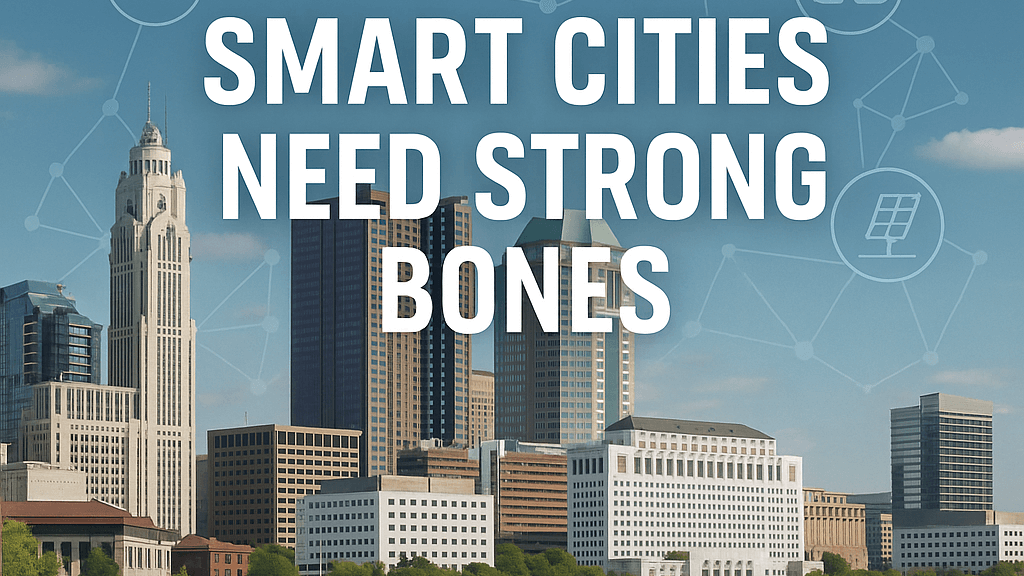
Everyone wants to talk about “smart cities” — sensors, electric vehicle grids, AI-powered logistics, and green mobility corridors. In Columbus, we’ve proudly embraced this vision through initiatives like Smart Columbus, positioning ourselves as a forward-looking, tech-enabled metro.
But here’s the truth no one wants to talk about:
Smart growth means nothing if your city is built on crumbling foundations.
While we chase data dashboards and EV charging stations, the bones of the city — its roads, bridges, stormwater systems, and public buildings — are aging, neglected, and in many cases, unsafe.
Innovation Can’t Stand on a Cracked Foundation
As a contractor who works in both restoration and new construction across Central Ohio, I’ve seen the duality up close: Smart sensors being installed on intersections sitting over 80-year-old sewer systems. New tech campuses flanked by sidewalks sinking into eroded clay.
We can’t engineer a smart future without reinvesting in what holds it all together:
• Our basements and footers
• Our retaining walls and bridge decks
• Our storm drains and slab-on-grade pads
• Our masonry, concrete, and steel supports
These aren’t glamorous investments. But they’re critical ones.
Three Real Needs for Smart City Stability
1. Proactive Structural Audits
Columbus must invest in structural surveys of aging public infrastructure — particularly schools, libraries, water facilities, and transportation corridors. Many of these assets are past their life expectancy.
2. Skilled Labor Pipeline
You can’t “app” your way out of a shortage of masons, carpenters, welders, and heavy equipment operators. Building a smart city starts with training the skilled trades to restore and reinforce its core.
3. Balanced Budgeting Between Innovation & Integrity
Let’s not build tomorrow’s tech on yesterday’s decay. City budgets need to equally prioritize maintenance, retrofit, and foundational repairs alongside smart initiatives.
The Path Forward: Tech + Trades
The smartest cities won’t be the ones with the most gadgets. They’ll be the ones with the strongest fundamentals — where smart design meets durable construction. Where predictive analytics guide infrastructure inspections, and where AI enhances logistics, not replaces hard-earned field expertise.
At Curatola Masonry, we work at the intersection of tradition and technology. We embrace innovation — but we also know that no smart city can succeed if the physical city underneath it is falling apart.
If you want a city that lasts — one that adapts, grows, and thrives — you don’t start with code.
You start with concrete, rebar, mortar, and brick.